



 STORIES FROM TUSCANY
Matteo Cerri: “I work with villages. In my novel, I added a murder”
A village in Maremma, a couple and an unscheduled death: the dark comedy The Village Was Lovely is now also published in Italian as Il paese era carino.
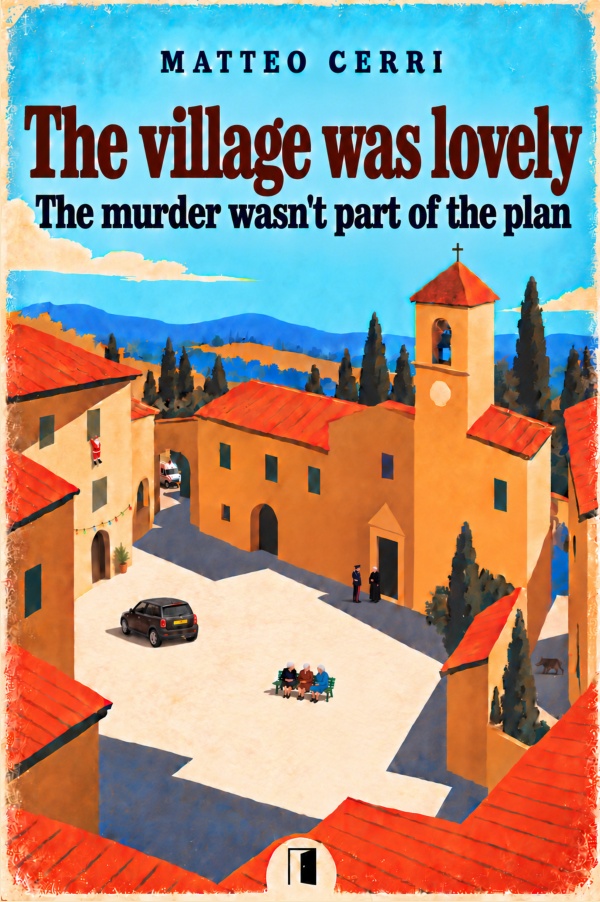
His work brings people and projects back to Italian villages. In his novel, Matteo Cerri brings a couple looking for a new life — and a decidedly unscheduled death. The Village Was Lovely — The Murder Wasn’t Part of the Plan takes place in Santa Pazienza, an imaginary village in Maremma: a dark comedy in which the mystery lights the fuse, but the living do the rest.
You work in villages, write about their beauty and encourage people to live there. Then you set a murder in one. Is that a risky promotional strategy?
It depends how much you trust brochures. Villages are beautiful, but people live in them. Those people have opinions, grudges, generosity, little pockets of power and memories that often outlast the roads. Treating a village as a postcard removes its most interesting feature: its inhabitants. In the novel, the murder complicates a situation that was already quite demanding in human terms.
How did the book begin?
With two perspectives meeting: someone arrives believing they have found the perfect place, while someone who has always lived there has no intention of being told how it should work. Working with communities, you encounter that distance all the time. The novel turns it into fiction, exaggerates it, and puts a couple, a house, a Mini and a dog in the middle. Writing it took about six months: finding a lovely village is relatively easy; getting all its characters to coexist in one story is rather harder.
Where does the story take us?
To Santa Pazienza, an imaginary village in Maremma. Anna and Marco arrive for six months in Tuscany, buy a house and try to decide whether this could become their place in the world. Meanwhile, the village tries to work out who they are, preferably before they manage it themselves. Then Arturo Bellandi dies at the village festival and things become complicated. Everyone seems to know something; fitting their accounts together is another matter.
So is it a detective novel?
I would describe it first as a dark comedy. There is a death, there is a mystery and readers can follow the investigation. But its heart is the human comedy: a couple trying to understand each other, neighbours, unfinished sentences, favours becoming debts, and the gap between what people say and what they do. The death gets the village moving. The village was already quite capable of creating problems without its help.
How much of it is true? Should anyone in Maremma be worried?
Santa Pazienza is invented and the characters belong to the novel. The human behaviour is recognisable: anyone who has lived in a small community knows a conversation that carries on after everyone has gone home. But recognising a pattern does not mean recognising a person. This is not a list of neighbours with their names changed, or reporting disguised as fiction.
Can we read it in English or in Italian too?
At present, the book is available in English on Amazon as The Village Was Lovely — The Murder Wasn’t Part of the Plan. The Italian edition is coming soon. There are also plans for selected bookshops, including in Tuscany: we will announce the shops when availability is confirmed.
Why start in English with such an Italian story?
I have lived in London for many years and a significant part of my editorial work addresses an international audience. I wanted to reach people looking at Italy from abroad, perhaps dreaming of a village house and having imagined everything except the neighbours’ meeting. The distance between the Italy people dream of and the Italy they live in is fertile ground for comedy. Starting in English reaches those readers; the Italian edition will add the perspective of people who know some of these dynamics all too well.
Will Anna, Marco and Santa Pazienza return?
I would like to meet them again. A community like that does not easily run out of ways to complicate its own life, and a couple just beginning to belong somewhere still has plenty to discover. For now, I am not announcing a date or a second title. Let us say that Santa Pazienza has enough human material to keep them from enjoying too much peace.